How to post consistently on LinkedIn to grow your reach and impressions

Ask anyone who’s tried to build a presence on LinkedIn and they’ll tell you a version of the same story.
You kick things off with enthusiasm → A few early posts gain some traction → But then some posts don’t perform as well → Other urgent tasks pop up → Before you know it, your motivation evaporates → “I’ll get back to it next quarter,” you say.
It’s an understandable situation. But the algorithm and your audience reward those who keep the content flowing.
Buffer’s analysis of more than two million LinkedIn posts found that posting more often matters. Significantly. For example, making the jump from posting once a week to posting two to five times a week earned over 1,000 more impressions per post. In other words, your posts themselves perform better, and of course, you’re posting more of them - so it’s a win-win.
Accounts posting six to ten times a week did better still: their average engagement rate was 0.76 percentage points higher than the once-a-week accounts. And there’s no point where the curve flattens out: posting more, within reason, keeps paying off.
Consistency on LinkedIn matters for people and companies
For an individual, building a presence on LinkedIn is a slow-burn. Trust and recognition come from showing up consistently, not from a single post that has gained traction. If you post sporadically, chances are people will soon forget you. On the other hand, if you share your insights and updates on a regular basis, you may become the first person that clients, ex-colleagues, or journalists think of first when the right opportunity comes along.
The same principle applies to companies. Every colleague who posts is a small distribution channel of their own. Plus, they have more reach and credibility than a company page will ever have. So, a business with a handful of consistent voices on LinkedIn can dramatically increase their overall visibility, helping them stay top-of-mind with potential clients, partners and employees.
But building a team of brand ambassadors who post regularly can only work if habits are built. LinkedIn training sessions can get the ball rolling with an initial burst of enthusiasm. But without structure and support this tends to fizzle out once the workload picks back up, or when posts don’t perform as well as you would hope.
Why consistency is so hard to keep up
Anyone who’s ever tried to write regularly knows these hurdles all too well.
Time is the most obvious challenge: a well-crafted post usually requires much more time than you would think. Plus, maintaining quality is no easy feat. Anyone can hit that publish button, but consistently creating something meaningful and unique is another question entirely.
Then there is writer’s block, where you run out of ideas on what to post. After tackling the obvious topics, many people find themselves staring at a blank screen, unsure of what’s really worth sharing.
Finally, and perhaps most importantly, there is the psychological question. Motivation can take a nosedive when posts don’t get the attention you were hoping for. A few weeks of your LinkedIn posts performing badly, and it’s easy to convince yourself that LinkedIn just “doesn’t work” for you.
Build a LinkedIn system to keep posting consistently
Relying on willpower alone will not work for the vast majority of people. What does work is putting in place a system that builds your habits and helps you overcome the challenges of posting consistently on LinkedIn.
Here are 5 foundations that an effective system should be built on.
- Lower the bar for what counts as a post (in terms of quantity, not quality). Most people wait for a “big” idea and end up publishing nothing. A short observation, a client question you’ve answered twice this month, or a one-line opinion on something in your industry is sometimes enough. Consistency beats scale.
- Batch your thinking, not just your writing. Set aside twenty minutes a week to jot down three or four raw ideas, even in note form. Turning a rough idea into a post later is far easier than starting from a blank page under time pressure. Plus, your mind will start subconsciously thinking through these topics, which means when it comes to actually writing, you’re more likely to have an interesting perspective on them.
- Build a loose content plan. A monthly map of topics, tied to what you actually know, removes the need to invent something new every single week. It doesn’t need to be rigid. Just enough structure that Monday morning doesn’t start with anxiety about posting on LinkedIn.
- Learn to tell stories. The posts that land on LinkedIn usually work like a scene, not a bulletin: something specific, something at stake, and a change by the end. The good news is that you don’t have to invent them from scratch every single time. There are age-old storytelling techniques and prompts that you can use to find stories for your posts.
- Monitor what works and make adjustments. Pay attention to which posts spark a conversation and which ones get scrolled-past. Over time, it’ll become second nature to identify the types of topic and message that will resonate with your audience.
What about just using AI to write the posts?
It’s tempting: AI is fast, it doesn’t make typos, and it never runs out of things to say. But on a platform as saturated as LinkedIn, this comes at a cost. AI drafts tend to be bland, and readers can usually tell a post wasn’t actually written by the person posting it.
Vanilla AI content is everywhere
More than half of long-form LinkedIn posts are now likely AI-generated. But this doesn’t fool anyone. In categories like marketing, strategy, and healthcare, human-written posts pulled in noticeably more engagement than AI-generated posts covering similar ground - in marketing and branding, by as much as 73%. AI content only reliably held its own in one category: motivational leadership posts, the kind of writing that rewards a strong opening line more than any actual depth.
AI struggles with storytelling
A recent research study by IPSOS into the effectiveness of AI vs Human-created ads had an interesting finding. Only 30% of the AI-generated ads attempted a storytelling approach, as opposed to half of the human-generated ones.
And according to the human subjects in the IPSOS study, when AI did attempt storytelling, it often missed the mark. The result was less emotion and engagement from these ads. Translate this to LinkedIn content, and it’s clear that, while AI tools are definitely helpful in structuring insights and quickly generating a draft, a human hand is needed to turn this into a real story that your audience relates to.
Writing time is thinking time
There’s also a more subtle downside of relying too much on AI. Writing your own posts, or talking them through with a ghostwriter, is time spent thinking. If you just hand this part of the process to a machine, you miss the opportunity to work out what you actually think. This compounds over the long-term into hundreds of hours of reflection, analysis and thinking that you miss out on. Sure, it takes effort. But it also gives you greater clarity and understanding, so that when you’re explaining these thoughts in person to a client, colleague or investor, you understand them deeply.
Where outside support can fit in
Outside support - be it an agency, a freelance writer, or a coach - can play very different roles depending on what your needs are.
At the lighter end, 3rd parties can set you up with a system that works for them. There are plenty of snake oil salespeople out there promising crazy results if you buy their system. And of course, these are to be avoided. But having an experienced communicator share their setup, routine and mindset can really help - it saves you from having to invent them from scratch for yourself.
Deeper support would include working out your voice and building a realistic content plan. Workshops or quick consultations can easily achieve this, and help to overcome the writer’s block challenge.
At the other end of the spectrum there is hiring a full writing coach. A writing coach can be used as a sounding board - someone to test an idea on before it goes live. They can be your editor, taking your first drafts and finessing them, while providing critical feedback that helps you improve as a writer. Or they can do ghostwriting, which is where they interview you regularly and turn your thinking into posts that sound like you. Which service you need usually depends on your level of experience and your goals.
Professional writers have a level of craft that takes years to build, and they can often spot interesting angles in a story you’ve missed or AI has overlooked.
Consistency starts with an aim
The starting point to consistently posting on LinkedIn, and enjoying the business benefits that brings, has to be a clear target. If you haven’t set that already, it’s time to define how much you want to grow and what you want that growth to bring.
Then get posting, use the tips shared above to help, and consider how support from professional writers can keep your consistency and quality up on LinkedIn.
More articles

What client-friendly legal writing actually looks like
Most legal correspondence is still written with other lawyers in mind. For clients, this often means impenetrable texts that confuse more than they clarify. This may seem like a trivial matter, but it’s actually costing your legal firm. Here’s why: Clients routinely struggle to understand the documents and letters their lawyers send them. Jargon-packed emails … <a href="https://firstimpression.works/client-friendly-legal-writing/">Continued</a>

Why we need a new approach to online presenting
It is time to say enough is enough to bad online meetings. Here is why: Knowledge workers have reached “communication overload”. Online meetings are responsible for a lot of this communication overload, yet a many of these meetings are ineffective. And badly managed online meetings have a knock-on effect on energy and motivation. Getting better … <a href="https://firstimpression.works/new-approach-to-online-presenting/">Continued</a>
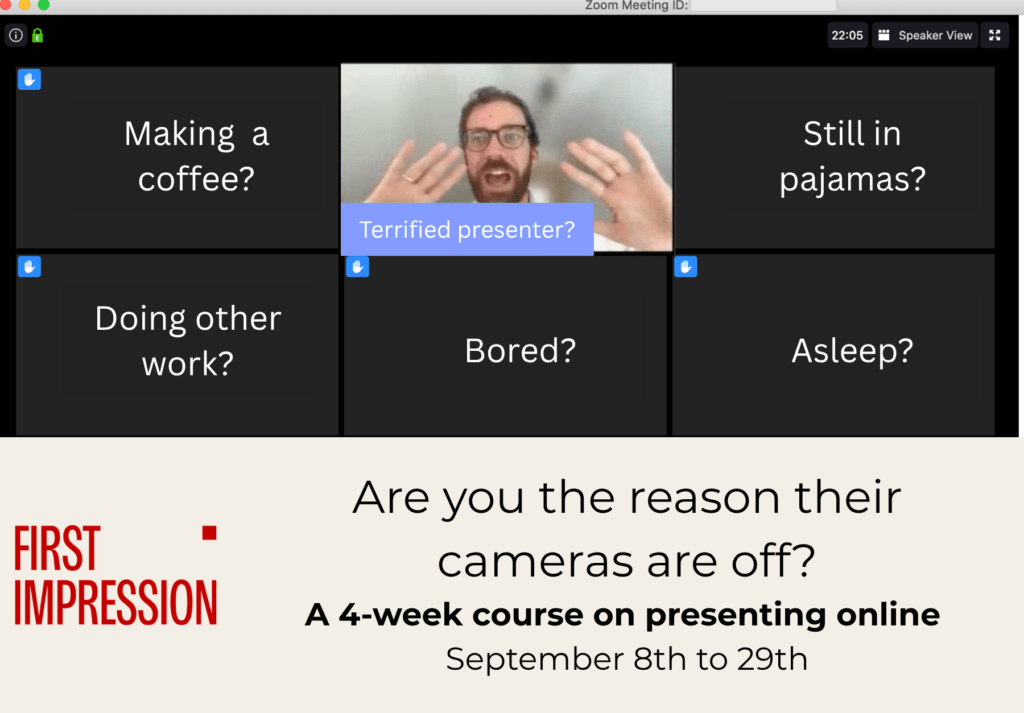
Presenting online: are you the reason their camera is off? A new online course
We’re excited to announce we’re launching our first public course on presenting online this September. 4 weeks of practical training to help you keep cameras on, hold attention, and run meetings people actually want to be in. The problem with online presenting Bad presentations are costly. A recent Harvard Business Review survey found that 90% … <a href="https://firstimpression.works/are-you-the-reason-their-cameras-off-presenting-online-course-september-2026/">Continued</a>