What client-friendly legal writing actually looks like

Most legal correspondence is still written with other lawyers in mind. For clients, this often means impenetrable texts that confuse more than they clarify.
This may seem like a trivial matter, but it’s actually costing your legal firm. Here’s why:
- Clients routinely struggle to understand the documents and letters their lawyers send them.
- Jargon-packed emails waste your client’s time and make it harder to build trust and confidence in the legal advice you’re giving them.
- Firms that successfully address this and master client-friendly legal writing enjoy faster sign-offs, fewer clarifying calls, and improved client loyalty.
Even lawyers get lost in legalese
The research backs up what clients have been saying for years. Legal writing has a real comprehension issue. A 2023 study from MIT revealed that even seasoned lawyers remembered much less from traditional “legalese” contracts as compared to plain-English versions of the same clauses. When given a choice, they overwhelmingly favoured the plain-English drafts.
Legalese costs you in terms of comprehension, and it impacts confidence. Research published this year in the Journal of Applied Communication Research found that overloading a text with jargon reduces people’s confidence in their own decisions. Over time, this leads to a loss of trust in the whole process. If courtroom jargon can shake a lawyer’s confidence, we can safely assume it is making clients second-guess the advice they’re paying for.
Four ways to write legal English texts with the client in mind
So, how do we make ourselves clear to clients when communicating about complex legal topics?
First Impression’s Legal Training workshops are built around four practical strategies, each grounded in real contract and correspondence examples.
1. Tone of voice in your legal writing
How we sound to a client comes down to small, deliberate choices in our writing. For example, do we put a person or a thing at the centre of a sentence? And then, do we write in the active voice or the passive voice?
To understand why this matters, look at the difference between these two sentences:
- Passive voice, focused on a thing: “This agreement may not be assigned without the prior written consent of the other party”
- Active voice, focused on a person: “The buyer may assign the agreement if the other party gives prior written consent.”
The legal meaning remains exactly the same, but option 2 is much easier to read and understand.
2. Structuring your legal messages
When we’re summarising a dispute or setting out a course of action, we can lean on a simple structure to keep the story clear: Situation, Target, Action, Result (STAR).
Here’s an example of a rather jumbled explanation that’s hard to follow:
“It worked out in the end because the team pulled together, even though our supplier let us down and the contract only gave us two weeks to sort it out.”
And here’s the same thing using the STAR method:
“Our supplier failed to deliver on time. We had two weeks under the contract to get a replacement. The team sourced an alternative supplier, and we delivered on schedule.”
3. Shorter sentences and concise writing
To make our texts easier to follow, we can break long sentences into shorter ones. Legal documents like contracts and agreements rely on highly complex sentences. That’s because all the relevant details and provisions must be included within a sentence to make sure the meaning is contractually binding.
But in communication with clients, it’s important to break down these long sentences into shorter ones that are easier to digest. We can also look for opportunities to swap a wordy phrase like “came to the conclusion” for a simpler verb like “concluded”.
4. Universally-understood vocabulary
English legalese is full of vocabulary that means something highly specific in a legal context. Only people with legal training or experience will be able to correctly understand it. This includes words like “shall”, “hereinafter,” and “therefor.”
Beyond this vocabulary, legal texts also use complex words and expressions that may be difficult for clients to understand - “in accordance with,” “undertake,” or “discretion.”
To be clear, it’s fine to include this vocabulary in formal legal documents. But they should be removed from your emails and everyday communication, and replaced with universally understood alternatives. This can be difficult for lawyers because they’re constantly exposed to this vocabulary and it feels natural to them. For their clients, however, it’s likely to sound confusing and feel alienating.
Make communication your law firm’s competitive advantage
The problem of unclear legal communication is widespread. This is a problem, but also represents an opportunity. Legal firms that prioritise clear communication and improve their writing to put the client first can set themselves apart from the competition.
Are you ready to put your clients first and make communication your competitive advantage? Book your free consultation today - I have decades of experience supporting law firms with their communication and I’m to help your team level up their legal writing.
By Malcolm Stewart,
Partner at First Impression, Communication trainer and coach
More in Training
You might also like

Why we need a new approach to online presenting
It is time to say enough is enough to bad online meetings. Here is why: Knowledge workers have reached “communication overload”. Online meetings are responsible for a lot of this communication overload, yet a many of these meetings are ineffective. And badly managed online meetings have a knock-on effect on energy and motivation. Getting better … <a href="https://firstimpression.works/new-approach-to-online-presenting/">Continued</a>
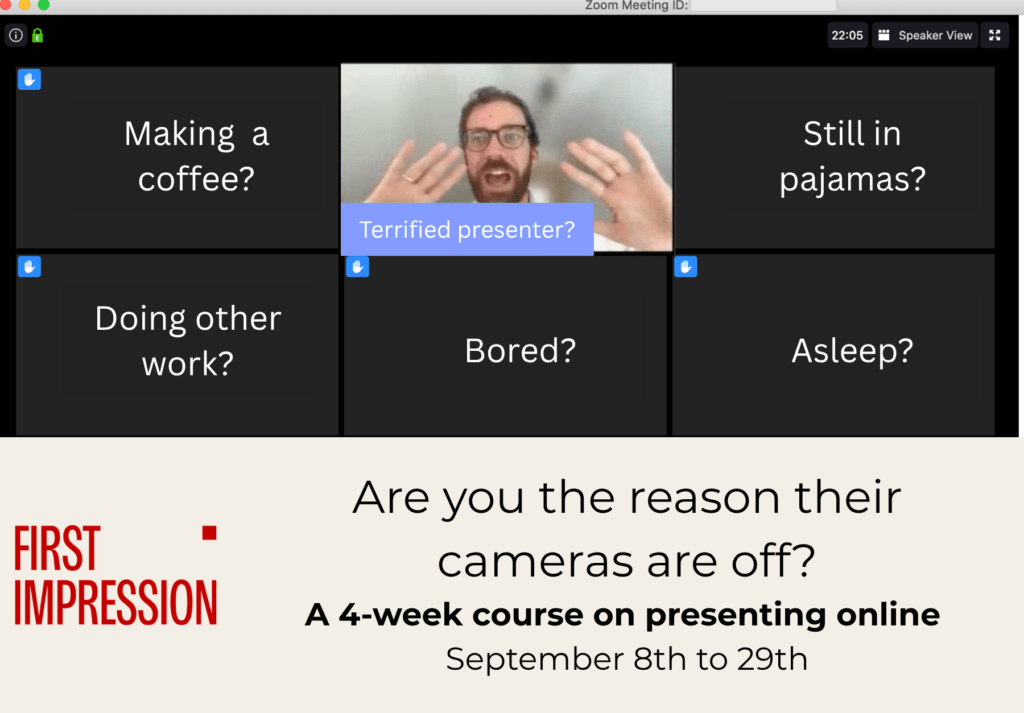
Presenting online: are you the reason their camera is off? A new online course
We’re excited to announce we’re launching our first public course on presenting online this September. 4 weeks of practical training to help you keep cameras on, hold attention, and run meetings people actually want to be in. The problem with online presenting Bad presentations are costly. A recent Harvard Business Review survey found that 90% … <a href="https://firstimpression.works/are-you-the-reason-their-cameras-off-presenting-online-course-september-2026/">Continued</a>