Weird stories double ad effectiveness, and can make your LinkedIn posts more memorable too

Earlier this year, global market research firm Ipsos published Misfits Stories, its report based on an analysis of 15,000 video ads. One of the report’s headline findings was this:
Ads that tell a story are twice as effective at changing people’s behaviour.
And a specific type of storytelling performed best of all. These were stories that showcase what they called a “misfit mindset,” embracing the weird, illogical, and humorous. Ads with this type of storytelling were 3 times more effective.
But what does effectiveness really mean? And what does this have to do with your LinkedIn posts? Let’s find out, and take a look at some real-life LinkedIn posts showing these qualities.
We help companies and thought leaders post consistently on LinkedIn. Want to learn more?
What makes a story good?
Ipsos had a very specific definition of ‘effective’ for its analysis. It wasn’t only looking at memorability, but also at an ads’ ability to “change behaviour to the benefit of the brand.”
As we’ve already mentioned, ads with stories performed much better at changing behaviour. But what exactly did these stories look like? In Ipsos’s research, a story was defined as “a sequence of events with characters and outcomes”. And according to the report, effective storytelling should give the audience at least one of the following experiences:
- Participation: The storyteller holds information back, so the audience fills in the gaps and anticipates what happens next.
- Escapism: The story takes people out of their everyday lives, into an imaginary world, or a version of the real one with some unusual elements that make it more fun.
- Connection: The characters give the audience someone to relate to and a reason to care how things turn out.
Here’s an example of two of those experiences (participation and connection) in action. In this post by Edvin Vosylius, we are introduced to a relatable character (a sales rep about to start a new job) and we are encouraged to anticipate what will happen next.
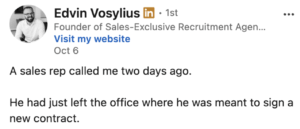
Clearly, the rep didn’t sign, which leaves us with a question: what went wrong? The rest of the post tells the story, while also providing advice on what to do in a similar situation. It gained hundreds of engagements, comments, and reshares.
From ad research to LinkedIn tactics
Adding these experiences (participation, escapism, connection) to your LinkedIn storytelling will help to give them more structure and engagement. And then to make them really pop, here are 3 specific tactics you can try based on Ipsos’ research into ads.
Use humour that invites people in
Ipsos found that ads using humour were 14% more likely to be top-third performers on memorability when the humour asked the audience to take part. Among the humour tactics Ipsos measured, playfulness made the biggest contribution to memorability (20%). Verbal and visual humour (15% each) and irony (13%) also performed well.
On LinkedIn, this could mean finding playful angles on the topic you’re describing, or wording a message or tactic in a funny way.
This example by Prakhar Sharma shows these qualities. He’s highlighting a significant and relatable problem on LinkedIn - annoying (and somewhat cynical) posts that use a “comment X to get Y” formula. But to make it humorous and light, Prakhar chooses a weird and nonsensical example - “comment bear to get honey.”
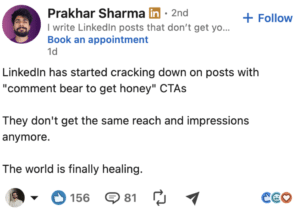
It’s a playful way to address a seriously annoying issue. Using a slightly surreal example also has a tiny pinch of escapism in it. Prakhar also signs off with “the world is finally healing,” which is not exactly irony, but is definitely sarcasm - exaggerating the scale of the problem for comic effect.
Surprise your reader
In the ad research, twist endings made the largest contribution among the unexpected and illogical tactics (20%), followed by something unexpected that doesn’t make sense (16%) and misdirection (15%). And these types of ads performed well.
As for what this could mean for posting on LinkedIn, you’re only limited by your own imagination. In this example, Laurie Ross gives a surprising and extreme example to back up her point that the German language is very direct and to-the-point.
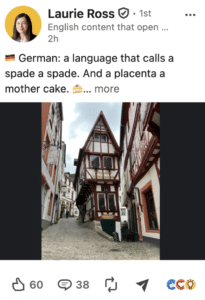
Choosing a surprising (and slightly weird) example makes you want to read more, and also sticks in your mind.
So, to use this tactic yourself, try to make a sharp pivot that no one sees coming. As long as it’s clever and/or funny, you’re golden.
Make it relatable
Relatable stories accounted for 41% of what made an ad a top-third performer on behaviour change. In Ipsos’ words, “stories people can connect with are five times more important than emotions”. Emotion helps people remember an ad, but they change their behaviour only when the ad shows situations and challenges they recognise from their own lives.
For LinkedIn, choose situations your audience has been in themselves, such as a meeting that overran or a proposal that was turned down. These will have more impact than a dramatic story that could’ve only happened to you.
Take this example of a one sentence “story” by Tomas Laurinavicius.
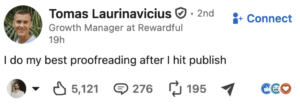
Anyone publishing regularly on LinkedIn will empathise with this feeling, so Tomas creates a connection with his audience.
Your competitors on LinkedIn aren’t telling stories
Only 49% of the 15,000 ads Ipsos analysed told a relatable story. The other 51% were, as the firm put it, “just talking about themselves”.
Storytelling on LinkedIn is just as rare. The examples above are the exceptions, with most posts giving announcements, sharing opinions and or going through listicles.
When feeds are full of “thrilled to announce” posts, or variations on “I proposed to my girlfriend. Here’s what it taught me about B2B sales,” a relatable story will really stand out. Especially if it features humour or surprise and is relatable.
Human stories beat AI slop
AI detector Pangram found that 41% of long-form posts on LinkedIn are AI generated, the highest of any social media platform.
And another piece of research by Ipsos might give us a clue as to how these posts perform. It got 3,000 US consumers to watch 10 AI-generated and 10 human-made ads, and the humans came out on top.
When people were asked to compare them side by side, 46% found the human ads to be more creative, compared to 27% for the AI creations. When it came to entertainment value, human ads scored even higher at 55% compared to 48% for AI.
Most notably, the AI-generated ads told fewer stories, using storytelling only 30% of the time.
Stand out with a story
On a platform full of AI-generated posts, a well-told story shows readers there’s a real person behind the profile. And adding participation, escapism, and connection, while dialing up the humour, surprise and relatability, will make these posts memorable and impactful.
So, next time you write a post, try this flow:
- pick a person your audience will recognise (it could be you),
- tell them what happened to that person,
- add a surprising twist,
- find a couple of places to add in some humour, whether it is a playful idea or some funny wording.
Let’s fill LinkedIn with stories that stand out.
By Michael Pennock
Partner at First Impression, communication trainer, copywriter, wannabe stand up comic, learning to love LinkedIn.
More in Content
You might also like

What client-friendly legal writing actually looks like
Most legal correspondence is still written with other lawyers in mind. For clients, this often means impenetrable texts that confuse more than they clarify. This may seem like a trivial matter, but it’s actually costing your legal firm. Here’s why: Clients routinely struggle to understand the documents and letters their lawyers send them. Jargon-packed emails … <a href="https://firstimpression.works/client-friendly-legal-writing/">Continued</a>

Why we need a new approach to online presenting
It is time to say enough is enough to bad online meetings. Here is why: Knowledge workers have reached “communication overload”. Online meetings are responsible for a lot of this communication overload, yet a many of these meetings are ineffective. And badly managed online meetings have a knock-on effect on energy and motivation. Getting better … <a href="https://firstimpression.works/new-approach-to-online-presenting/">Continued</a>
Presenting online: are you the reason their camera is off? A new online course
We’re excited to announce we’re launching our first public course on presenting online this September. 4 weeks of practical training to help you keep cameras on, hold attention, and run meetings people actually want to be in. The problem with online presenting Bad presentations are costly. A recent Harvard Business Review survey found that 90% … <a href="https://firstimpression.works/are-you-the-reason-their-cameras-off-presenting-online-course-september-2026/">Continued</a>