Why we need a new approach to online presenting

It is time to say enough is enough to bad online meetings. Here is why:
- Knowledge workers have reached “communication overload”.
- Online meetings are responsible for a lot of this communication overload, yet a many of these meetings are ineffective.
- And badly managed online meetings have a knock-on effect on energy and motivation.
Getting better at presenting online is one way we can recover some of this time, while boosting productivity and removing energy drags that demotivate our team. And to be a more effective online presenter, we must learn to:
- manage time,
- manage content,
- and manage energy.
Sign up to watch our free webinar recording on effective online presenting
Communication overload
The modern workplace has reached communication overload. For knowledge workers, a staggering 57% of their time is spent communicating, according to a Microsoft analysis last year of trillions of data points from Microsoft 365.
Online meetings are a major culprit (and an energy drain)
For the average knowledge worker, 28% of their time is eaten up by meetings, Microsoft’s data shows. And the majority of these are now held either fully or primarily online.
Not only are many of these meetings unproductive (an estimated one third of all meetings are a waste of time), they are also draining. A recent Harvard Business Review survey found that 90% of people experience a “hangover” after a bad meeting.
Online meetings are especially problematic for this. When remote work exploded during COVID, multiple studies showed that visual tiredness and lack of movement all contributed to “Zoom fatigue.”
Online meetings have a higher “cognitive load” than their in-person equivalents. Looking at yourself and multiple others on screen simultaneously is mentally draining. And it takes extra effort to avoid distractions on screen - on average, we get an interruption every 2 minutes during our working day.
While recent research shows that Zoom fatigue is becoming less of an issue as we adapt to having mostly meetings online, the fact remains that remote presentations and meetings have unique challenges when it comes to staying focused and using our time productively.
If we can’t replace online meetings, we can fix them
Why are we having meetings at all? Well, the fact remains that meetings are valuable when done right. Accordingly to a survey by Calendly, more than half of us find that meetings actively enhance productivity at work.
Key benefits noted include better engagement with leadership and managers, increased connection with colleagues, and more visibility into other projects and tasks. Sessions focused on decision-making, goal-setting, problem-solving, and progress reviews are all viewed as among the most valuable meeting types.
And when it comes to presentations to partners and clients, face time is an essential tool for establishing deep trust and opening up dialogue so you can truly understand their problems.
Becoming a master at presenting online
The first step to solving our communication overload is to cut out any unnecessary meetings.
But once that is done, how do we improve the essential and valuable meetings we still need to have?
Well, we can turn them into positive, productive time spent together by mastering online presentation and facilitation. And there is a three-word mantra to kick-start this process: time, content, energy.
Time: Researchers in Germany have found that 44 minutes is the upper limit for a productive online meeting. After this, energy levels, focus, and effectiveness all drop off. We can also think smarter about how we divide up those 44 minutes (or less) so that participants remain active and involved.
Content: Applying the same approach to structure, visuals, resources, activities, and text that we use in face-to-face meetings is a recipe for disaster. We need to adapt the content and structure of our sessions to mitigate the increased distractions and lack of personal interaction in online meetings.
Energy: This starts with your energy as a presenter. Arguably, it is harder to maintain your energy levels when you’re talking to a screen. And what about the energy of your participants? How can you monitor their engagement and find ways to keep them interested?
The good news is that presenting is a skill that can be learned and honed. And presenting online is a specific form of that skill (no, the body language techniques you learned from your public speaking training won’t help you much here). All that’s needed now is a specialist approach to learning to present online.
If you’re ready to start your journey towards running better online meetings and presentations, watch our free webinar recording? Just enter your email below to get access to it.
And if you’re ready to become a better online presenter in just 4 weeks, take a look at our course running this September.
By Michael Pennock
Partner at First Impression, comms trainer and writer.
More in Training
You might also like

What client-friendly legal writing actually looks like
Most legal correspondence is still written with other lawyers in mind. For clients, this often means impenetrable texts that confuse more than they clarify. This may seem like a trivial matter, but it’s actually costing your legal firm. Here’s why: Clients routinely struggle to understand the documents and letters their lawyers send them. Jargon-packed emails … <a href="https://firstimpression.works/client-friendly-legal-writing/">Continued</a>
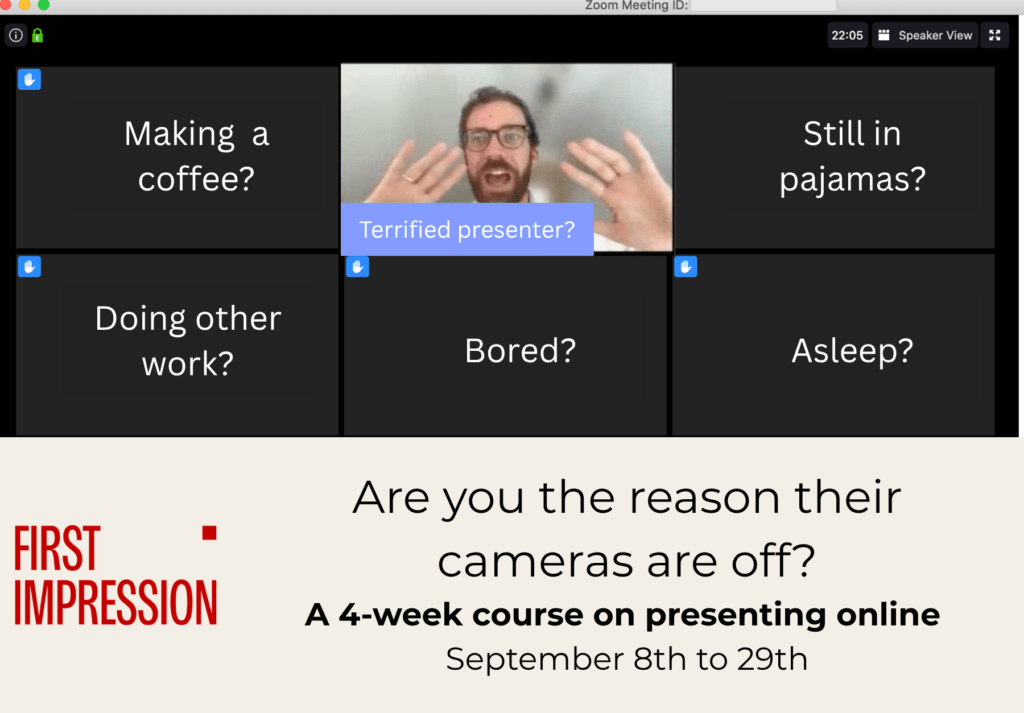
Presenting online: are you the reason their camera is off? A new online course
We’re excited to announce we’re launching our first public course on presenting online this September. 4 weeks of practical training to help you keep cameras on, hold attention, and run meetings people actually want to be in. The problem with online presenting Bad presentations are costly. A recent Harvard Business Review survey found that 90% … <a href="https://firstimpression.works/are-you-the-reason-their-cameras-off-presenting-online-course-september-2026/">Continued</a>